

Prime Highlights
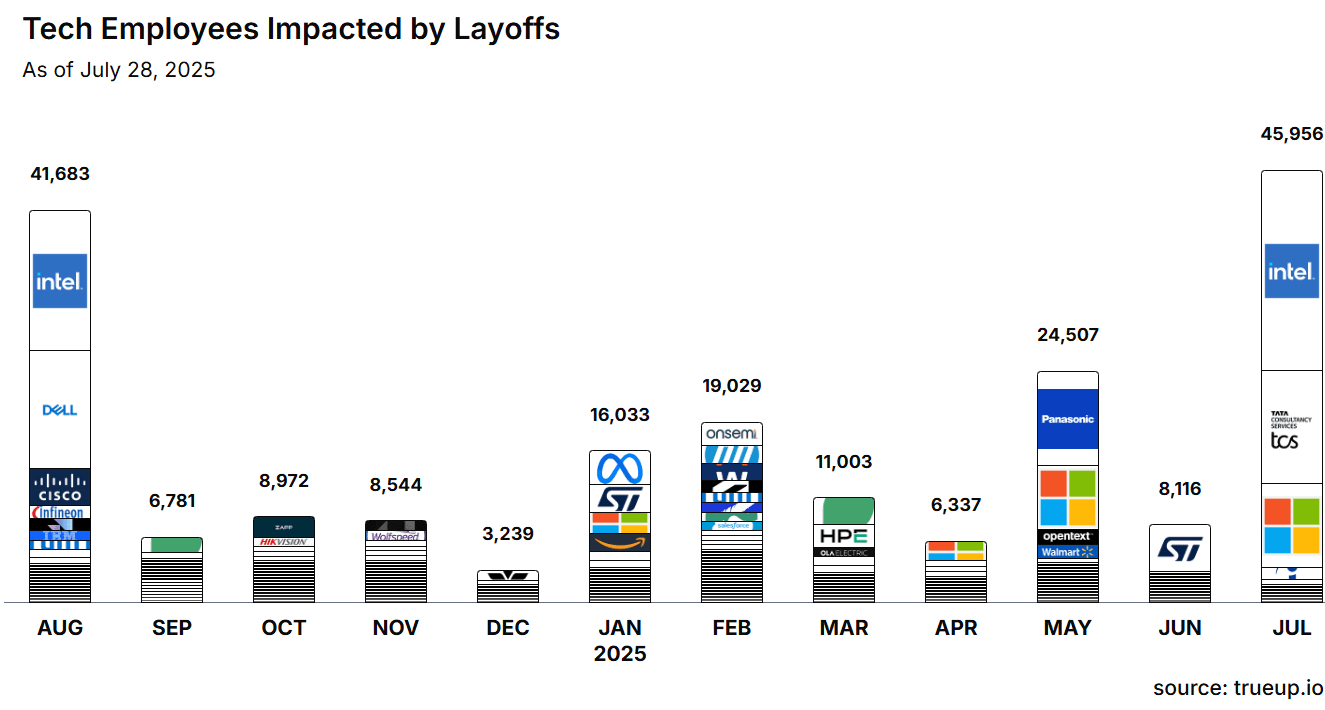
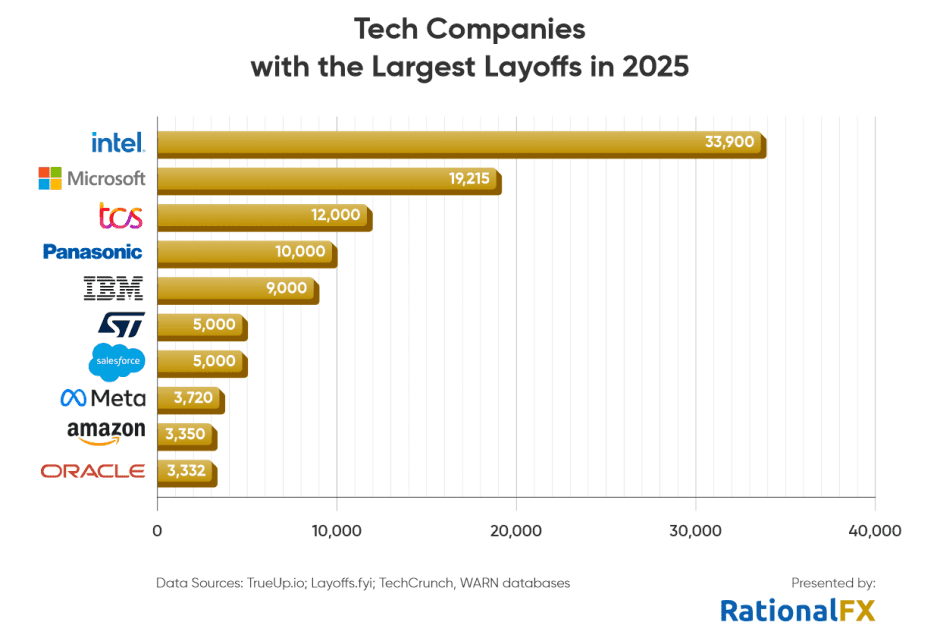
The global technology sector is witnessing one of its most significant workforce contractions in recent years, with over 200,000 job cuts expected by the end of 2025. Industry leaders such as Intel, Amazon, and Microsoft are among the major companies driving this wave of layoffs, reflecting deeper structural shifts in how tech businesses operate, invest, and scale.
The trend has sparked widespread discussion about the future of employment in technology, especially as companies balance cost control with rapid advancements in artificial intelligence and automation.
Key Facts
More than 200,000 technology roles are projected to be eliminated globally in 2025.
Major firms including Intel, Amazon, Microsoft, and other Silicon Valley giants are leading the layoffs.
Job reductions span across software engineering, cloud services, hardware, HR, and middle management roles.
Many companies cite efficiency, restructuring, and AI-driven automation as key reasons for downsizing.
Background
The technology sector experienced aggressive hiring during the pandemic years, fueled by digital acceleration, remote work, and booming demand for online services. As global economic conditions tightened and growth rates normalized, many firms found themselves overstaffed relative to current demand.
What it Means
The scale of layoffs signals a fundamental reset in the tech industry. Companies are moving away from growth-at-all-costs strategies toward profitability, operational discipline, and long-term sustainability. For employees, this means a more competitive job market and a growing emphasis on adaptable, high-impact skill sets. It also highlights a changing definition of tech work, where roles focused on AI, machine learning, cloud optimization, and product innovation are prioritized over traditional support and expansion roles.
Prime Highlights
The global technology sector is witnessing one of its most significant workforce contractions in recent years, with over 200,000 job cuts expected by the end of 2025. Industry leaders such as Intel, Amazon, and Microsoft are among the major companies driving this wave of layoffs, reflecting deeper structural shifts in how tech businesses operate, invest, and scale.
The trend has sparked widespread discussion about the future of employment in technology, especially as companies balance cost control with rapid advancements in artificial intelligence and automation.
Key Facts
More than 200,000 technology roles are projected to be eliminated globally in 2025.
Major firms including Intel, Amazon, Microsoft, and other Silicon Valley giants are leading the layoffs.
Job reductions span across software engineering, cloud services, hardware, HR, and middle management roles.
Many companies cite efficiency, restructuring, and AI-driven automation as key reasons for downsizing.
Background
The technology sector experienced aggressive hiring during the pandemic years, fueled by digital acceleration, remote work, and booming demand for online services. As global economic conditions tightened and growth rates normalized, many firms found themselves overstaffed relative to current demand.
At the same time, rapid progress in generative AI and automation tools has enabled companies to streamline operations, reduce manual workloads, and consolidate roles. This shift has accelerated restructuring plans across both Big Tech and mid-sized technology firms.
What it Means
The scale of layoffs signals a fundamental reset in the tech industry. Companies are moving away from growth-at-all-costs strategies toward profitability, operational discipline, and long-term sustainability. For employees, this means a more competitive job market and a growing emphasis on adaptable, high-impact skill sets.
It also highlights a changing definition of tech work, where roles focused on AI, machine learning, cloud optimization, and product innovation are prioritized over traditional support and expansion roles.
Outlook & Consideration
While the near-term outlook remains uncertain for many tech professionals, industry experts believe the layoffs could stabilize by mid-2026 as companies complete restructuring cycles. New opportunities are expected to emerge in AI-driven startups, enterprise transformation projects, and specialized technology consulting. For professionals, reskilling and continuous learning will be critical. For companies, the challenge will be maintaining innovation momentum while managing workforce morale and public perception. The current wave of job cuts may mark not a decline of the tech sector, but a transition into a more focused and efficiency-driven era.
Prime Highlights
The global technology sector is witnessing one of its most significant workforce contractions in recent years, with over 200,000 job cuts expected by the end of 2025. Industry leaders such as Intel, Amazon, and Microsoft are among the major companies driving this wave of layoffs, reflecting deeper structural shifts in how tech businesses operate, invest, and scale.
The trend has sparked widespread discussion about the future of employment in technology, especially as companies balance cost control with rapid advancements in artificial intelligence and automation.
Key Facts
More than 200,000 technology roles are projected to be eliminated globally in 2025.
Major firms including Intel, Amazon, Microsoft, and other Silicon Valley giants are leading the layoffs.
Job reductions span across software engineering, cloud services, hardware, HR, and middle management roles.
Background
The technology sector experienced aggressive hiring during the pandemic years, fueled by digital acceleration, remote work, and booming demand for online services. As global economic conditions tightened and growth rates normalized, many firms found themselves overstaffed relative to current demand.
At the same time, rapid progress in generative AI and automation tools has enabled companies to streamline operations, reduce manual workloads, and consolidate roles. This shift has accelerated restructuring plans across both Big Tech and mid-sized technology firms.
What it Means
The scale of layoffs signals a fundamental reset in the tech industry. Companies are moving away from growth-at-all-costs strategies toward profitability, operational discipline, and long-term sustainability. For employees, this means a more competitive job market and a growing emphasis on adaptable, high-impact skill sets.
It also highlights a changing definition of tech work, where roles focused on AI, machine learning, cloud optimization, and product innovation are prioritized over traditional support and expansion roles.
Outlook & Consideration
While the near-term outlook remains uncertain for many tech professionals, industry experts believe the layoffs could stabilize by mid-2026 as companies complete restructuring cycles. New opportunities are expected to emerge in AI-driven startups, enterprise transformation projects, and specialized technology consulting.
For professionals, reskilling and continuous learning will be critical. For companies, the challenge will be maintaining innovation momentum while managing workforce morale and public perception. The current wave of job cuts may mark not a decline of the tech sector, but a transition into a more focused and efficiency-driven era.
Outlook & Considerations
While the near-term outlook remains uncertain for many tech professionals, industry experts believe the layoffs could stabilize by mid-2026 as companies complete restructuring cycles. New opportunities are expected to emerge in AI-driven startups, enterprise transformation projects, and specialized technology consulting.
For professionals, reskilling and continuous learning will be critical. For companies, the challenge will be maintaining innovation momentum while managing workforce morale and public perception. The current wave of job cuts may mark not a decline of the tech sector, but a transition into a more focused and efficiency-driven era.
4/9
4/9
4/9
Tech Job Shakeup
Tech Job Shakeup
Tech Job Shakeup
Author: Ananya Kulkarni
Author: Ananya Kulkarni
Author: Ananya Kulkarni
Date of writing: 3 December 2025
Date of writing: 3 December 2025
Date of writing: 3 December 2025
x
x

English
𐊾